Computational Systems Biology · Independent Practice

From Omics Data to
Predictive Biology.

Deciphering cellular response, spatial architecture, and perturbation mechanics through reproducible computational systems biology.

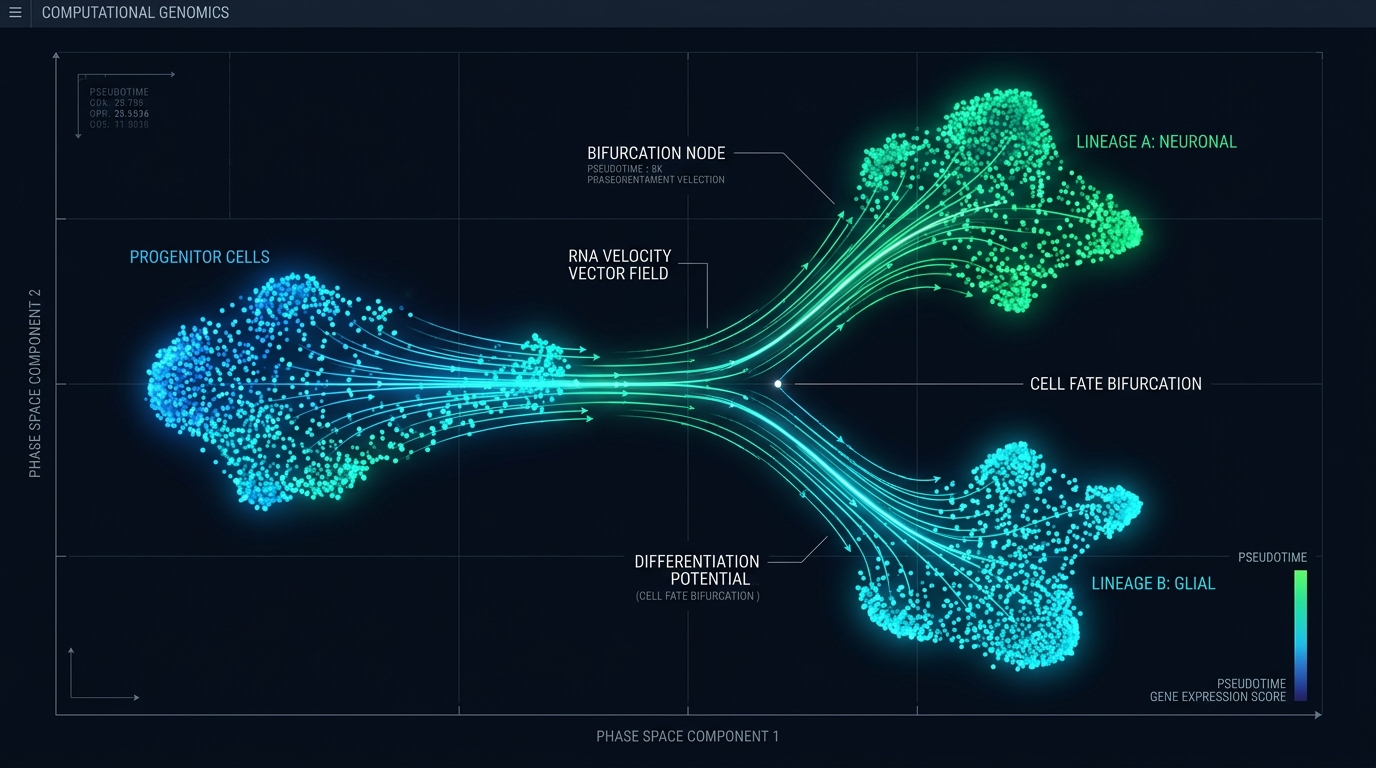
Cell fate trajectory and bifurcation manifold representing predictive systems biology
15+Years in Omics
11Peer-Reviewed Papers
8+Software Packages
5Spatial Platforms
Practice Overview

Understanding, Modeling, and Predicting Biological Systems

Omics with Johnson is my independent computational biology practice, uniting rigorous research, reproducible software pipelines, and specialized scientific consulting for research labs.

For the past decade, molecular biology has prioritized cataloging: generating static atlases and differential expression tables. But knowing what differs between conditions does not explain how a cell arrived there or how it will respond to intervention.

I focus on the transition from descriptive genomics to predictive systems biology: mapping continuous cellular response fields, stress-testing foundation models against empirical baselines, and developing deterministic, containerized pipelines.

Research LabScientific SoftwareLeveled EducationStrategic Advisory
Pillar 01 · Scientific Program

Four Core Research Themes

My research investigates how molecular state and spatial context govern cell fate decisions and therapeutic response.

Theme 01

Predictive Systems Biology

Cellular response fields, counterfactual prediction, and state transitions

Moving computational biology beyond descriptive differential expression toward mechanistic models of how cells shift between attractor states under genetic, chemical, and physical perturbations.

  • · Cell state dynamics & manifold learning
  • · Cellular response fields under perturbation
  • · Counterfactual in silico genetic screens

Theme 02

Single-Cell & Spatial Omics

Atlas-scale analysis, cell-state discovery, spatial organization, and multimodal integration

Developing computational foundations for spatial microenvironments, multimodal co-profiling (RNA + ATAC + protein), and high-resolution cell-state maps in complex tissues across five major spatial platforms.

  • · Atlas-scale integration across cohorts and technologies
  • · Spatial cellular niches & cell-cell communication
  • · Sub-micron Visium HD & Xenium spatial transcriptomics decoding
Theme 03

Scientific AI & Foundation Models

Representation learning, biological generalization, and rigorous model benchmarking

Evaluating what single-cell and biological foundation models can and cannot do. Investigating whether self-supervised pre-training yields genuine biological generalizability or memorizes batch statistics.

  • · Single-cell foundation model stress testing
  • · Out-of-distribution biological generalization
  • · Latent space geometry and biological interpretability (scVI / deep generative)
Theme 04

Disease Systems Biology

Kidney pathology, cardiovascular remodeling, oncology, and tissue repair

Applying systems-level omics and predictive frameworks to translational human pathology: dissecting maladaptive repair in kidney disease, smooth muscle cell plasticity in atherosclerosis, and myocardial repair.

  • · Renal tubular cell state transitions and chronic fibrosis progression
  • · Vascular smooth muscle cell (VSMC) phenotypic switching in plaques
  • · Tumor microenvironment barrier architecture and immunotherapy resistance
Applied Investigations

Featured Case Studies & Data Reports

In-depth spatiotemporal, single-cell, and multi-omics analyses re-analyzing published clinical trials and benchmark datasets.

Multi-Platform Spatial

The Kidney Spatial Transcriptomics Analysis

Systematic re-analysis of 128 publicly available spatial transcriptomics samples across five major platforms: GeoMx, Visium, Xenium, NanoString, and MERFISH. Mapping spatial cellular niches, microenvironmental boundaries, and cross-platform concordance.

Platforms: 10x Visium · Xenium · GeoMx · MERFISH · NanoString
Open Interactive Report
Editorial & Critical Perspectives

Scientific Insights & Analytical Thinking

Unpacking computational biology failure modes, single-cell foundation model stress tests, and statistical fallacies.

Open Source Infrastructure

Open Source Tools & Software

Bioinformatics software, Bioconductor packages, PyPI libraries, and reproducible pipelines authored and maintained by Dr. Qingzhou Zhang.

Python

SpatialRenal ↗

High-resolution spatial transcriptomics atlas of the kidney reconciling Visium HD, Xenium, MERFISH, GeoMx, and Nanostring data for detailed spatial structure and cellular organization.

View Repository
Bash / Nextflow

Epi-Flow ↗

Unified reproducible pipeline for chromatin accessibility and occupancy assays: ATAC-seq, CUT&RUN, and ChIP-seq. Container-ready with single-command execution.

View Repository
Python (PyPI)

scfeatureprofiler ↗

Multi-interface Python package for deep characterization and statistical profiling of gene expression patterns, marker distribution, and co-expression in single-cell data.

View Repository
R

ComplexMap ↗

Comprehensive R toolset for functional analysis, topological exploration, and publication-ready visualization of protein complex and interactome data.

View Repository
Pillar 04 · Partnership & Advisory

Work With Johnson

Fixed-scope computational biology consulting, single-cell/spatial analysis, and bespoke institutional workshops.

01Grant Planning · For PIs

Grant-Ready Preliminary Evidence

Use public data to test hypotheses and build credible preliminary evidence before sequencing

Identify suitable public cohorts and datasets (GEO, SRA, UK Biobank, TCGA, HCA) to test the biological signal behind your grant question and generate proposal-ready figures.

02Primary Advisory · 2-3 Wks

Single-Cell & Spatial Omics

Resolve cell states, tissue microenvironments, and treatment responses across platforms

Turn complex single-cell and spatial runs (10x Chromium, Visium HD, Xenium, MERFISH, GeoMx) into interpretable cellular neighborhoods, receptor-ligand communication networks, and disease states.

03Advanced Analysis · High Impact

Biomarker Validation & Multimodal Mechanism

Test signature transferability and connect multi-omics layers to clinical outcomes

Test whether a molecular signature remains robust and predictive across external cohorts, different sequencing platforms, and longitudinal time points. Connect RNA, ATAC, and proteomics layers.

04Institutional Training · Bespoke

Advanced Training & Private Workshops

Private workshops, institutional training, and advanced bioinformatics programs

Intensive, bespoke computational biology training engineered for wet-lab biologists transitioning to dry-lab, core facility bioinformaticians, and dry-lab scientists advancing to predictive modeling.

Dr. Qingzhou Zhang (Johnson)
Dr. Qingzhou ZhangComputational Systems Biologist & Bioinformatician
Pillar 05 · The Scientist

About Johnson & My Practice Philosophy

Omics with Johnson was created by Dr. Qingzhou Zhang, a computational systems biologist working at the intersection of genomics, single-cell analysis, and predictive modeling.

“Modern omics produces enormous amounts of descriptive data. The next challenge is not simply identifying what differs between conditions, but understanding biological states, predicting how systems change, and determining which interventions can alter those trajectories.”

I clearly distinguish between my scientific research as an investigator (Dr. Qingzhou Zhang), my consulting business & practice (Omics with Johnson), my peer-reviewed publications, and my open-source codebase on GitHub.